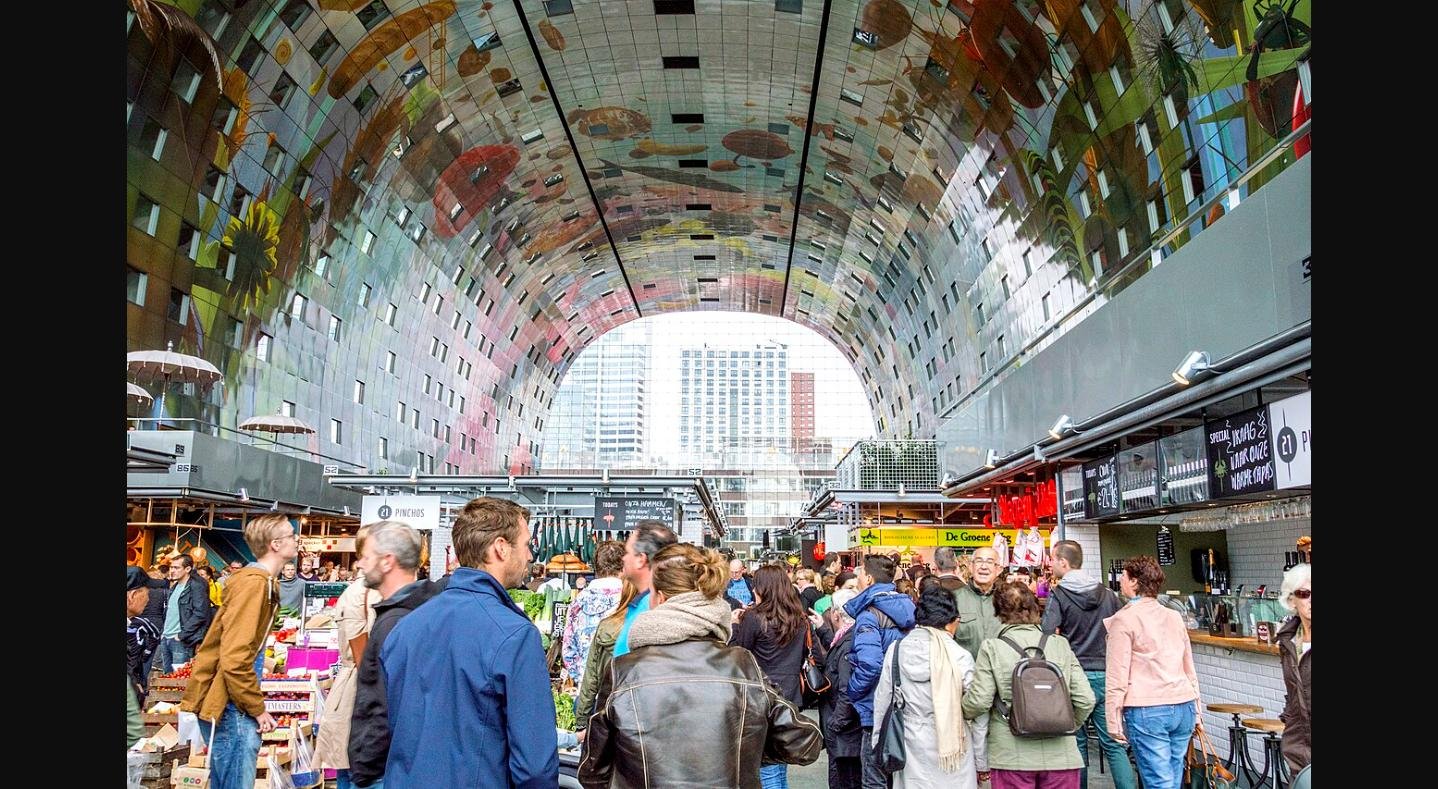
Photo: Paul van de Velde, CC BY 2.0, via Wikimedia Commons
Markthal Rotterdam is a horseshoe-shaped market hall and residential complex in the city's Centrum district, developed by Provast and designed by the Rotterdam architecture firm MVRDV. Construction began in 2009 and the building opened on 1 October 2014, unveiled by Queen Máxima.
Inside the arch, a ceiling artwork titled "Hoorn des Overvloeds" (Horn of Plenty) covers roughly 11,000 square metres across 4,000 perforated aluminium panels, created by artist Arno Coenen with Iris Roskam and photographer Frank Hanswijk. Above the market hall, 228 apartments wrap around the structure: 102 rental units and 126 freehold apartments, including 24 penthouses.
The ground floor holds more than 100 food stalls, restaurants and an Albert Heijn supermarket, a short walk from Rotterdam Blaak station.
What You Can Do Here
- Browse 100+ food stalls under the 11,000 m² "Cornucopia" ceiling artwork by Arno Coenen and Iris Roskam
- Pick up groceries at the Albert Heijn supermarket on the ground floor
- Walk in for free: no admission ticket, pay only for what you buy at the stalls
Getting There
Public Transport
Rotterdam Blaak · Rail, metro and tram interchange directly outside Markthal
Blaak · All three Rotterdam metro lines stop at Blaak
Blaak · Tram 1 and 11 (renumbered from 24 and 21 in January 2025)
Parking
Markthal underground garage (Interparking), Dominee Jan Scharpstraat 306
24/7 access with over 1,100 spaces, including EV charging and accessible bays (source: Interparking)
€1.75 per 20 minutes, €35.00 day rate
Accessibility
Markthal has step-free entrances, automatic doors, wide pathways and 26 lifts, with accessible restrooms on the ground floor. The raised stall terraces are reached by stairs only and are not wheelchair accessible. (Source: markthal.nl, Wikipedia)
A Square That Never Stopped Teaching
Before the glass facade and the painted ceiling, this exact spot held a school. Two of them, in fact. Generations of Rotterdam children learned to read and count in the post-war school building at the Grotemarkt, home to the Catholic Willibrordschool and the Montessori school Jan Prins. When the Markthal plans took shape, both schools moved in 2009 to a converted building at Nieuwstraat 15, one street behind today's market hall. They are still there. Their playground now sits on the roof, fourteen metres up, with a football cage overlooking the building that replaced their old classrooms.
The lesson simply changed subject. Where children once recited times tables, more than a hundred stalls now teach visitors what a ripe Dutch cheese smells like, and how stroopwafels taste when the syrup is still warm. Look up and the old classroom poster still hangs there, in a way. The Horn of Plenty ceiling, eleven thousand square metres of oversized fruit, grain, fish and flowers, reads like a giant botany chart for the whole city.
The teaching goes deeper than the market floor. Archaeologists dug down ten metres here before construction began and found a farmhouse from the tenth century, part of Rotta, the settlement that gave Rotterdam its name. This corner of Rotterdam's history has been schooling people for a thousand years. First it taught farmers to live with the river. Then it taught children. Now it teaches taste.
Timeline: From Riverbank to Market Hall
Ten centuries do not fit under one roof easily. Here is the short version, from a riverbank settlement to a landmark of modern Rotterdam architecture.
- c. 900–1100
- The settlement of Rotta stands on the banks of the river Rotte. During the Markthal excavations of 2009–2010, city archaeologists uncovered a tenth-century farmhouse seven metres below street level, complete with two ovens and open hearths.
- c. 1270
- A dam is built in the Rotte near today's Hoogstraat. The dam gives the city its name, Rotterdam. Its remains still lie beneath the street next to the Markthal.
- 14th century
- The site becomes part of the Westnieuwland polder. A late-medieval house named Keulen stands on the future Markthal footprint.
- 1871
- The Binnenrotte, the stretch of river inside the city, is filled in for an elevated railway viaduct on the Rotterdam–Dordrecht line.
- 14 May 1940
- The German bombardment destroys the Hoogstraat district, before the war Rotterdam's main shopping street.
- Post-war years
- A school building rises at the Grotemarkt. It houses the Willibrordschool and the Jan Prins Montessori school, with the Willem de Zwijgerschool also recorded here in the city archives.
- 1993
- The railway viaduct comes down after the Willemsspoortunnel opens. The Binnenrotte becomes one of the largest open squares in the Netherlands, hosting an outdoor market of over 450 stalls on Tuesdays and Saturdays.
- 2004
- MVRDV and developer Provast win the city's design competition with a horseshoe of apartments arched over a covered market.
- 2009
- Both schools move to Nieuwstraat 15, where a rooftop playground replaces their old schoolyard. Construction starts in October. Archaeologists dig first.
- 1 October 2014
- Queen Máxima opens the Markthal, the first covered fresh-food market in the Netherlands, built for roughly €178 million.
- 2015
- The building wins the Dutch NEPROM development prize, one of several national and international awards.
- Today
- Reported visitor counts have hovered around seven to eight million a year since the late 2010s. The schoolchildren still play next door, one roof higher than before.
The Time Stairs: A Free Museum Below the Market
Everything the archaeologists found stayed on site. De Tijdtrap, the Time Stairs, is a permanent, free exhibition built into the escalator hall and the parking levels -2, -3 and -4 of the Markthal. Visitors descend about fifteen metres and a thousand years at once, past display cases with kitchenware, tools, jewellery and weapons dug up right here. The deepest cases belong to Rotta, the farming settlement that predates Rotterdam itself. Few cities let you park your car inside an archaeological dig.
Architecture: A Horseshoe of Homes
MVRDV solved an unusual brief by bending an apartment building over the market like an arch, engineered with Royal HaskoningDHV. The horseshoe holds 228 apartments across eleven floors, four of them below ground, under a roof forty metres up. Both open ends are sealed with a cable-net glass facade of roughly 34 by 42 metres, among the largest of its kind in Europe. Inside, the Horn of Plenty by artist Arno Coenen and Iris Roskam covers the vault, around 11,000 square metres of artwork printed on 4,000 perforated aluminium panels.
Frequently Asked Questions
What stood on the site of the Markthal before it was built?
A post-war school building housing two primary schools, the Willibrordschool and the Jan Prins Montessori school. Both moved to Nieuwstraat 15 in 2009, directly behind the Markthal, where they still teach today. Deeper down, archaeologists found remains of Rotta, a tenth-century farming settlement.
Can you visit the archaeological finds under the Markthal?
Yes, for free. De Tijdtrap exhibition on parking levels -2, -3 and -4 displays the tools, jewellery and household objects excavated on this spot, reaching back a thousand years.
Is entry to Markthal free?
Yes. Markthal is a public market hall with no admission ticket; you only pay for what you buy at the stalls.
Is there a supermarket inside Markthal?
Yes, an Albert Heijn supermarket is located on the ground floor.
What are Markthal's opening hours?
Monday to Thursday and Saturday 10:00-20:00, Friday 10:00-21:00, and Sunday 12:00-18:00. Individual stalls and restaurants can vary.